

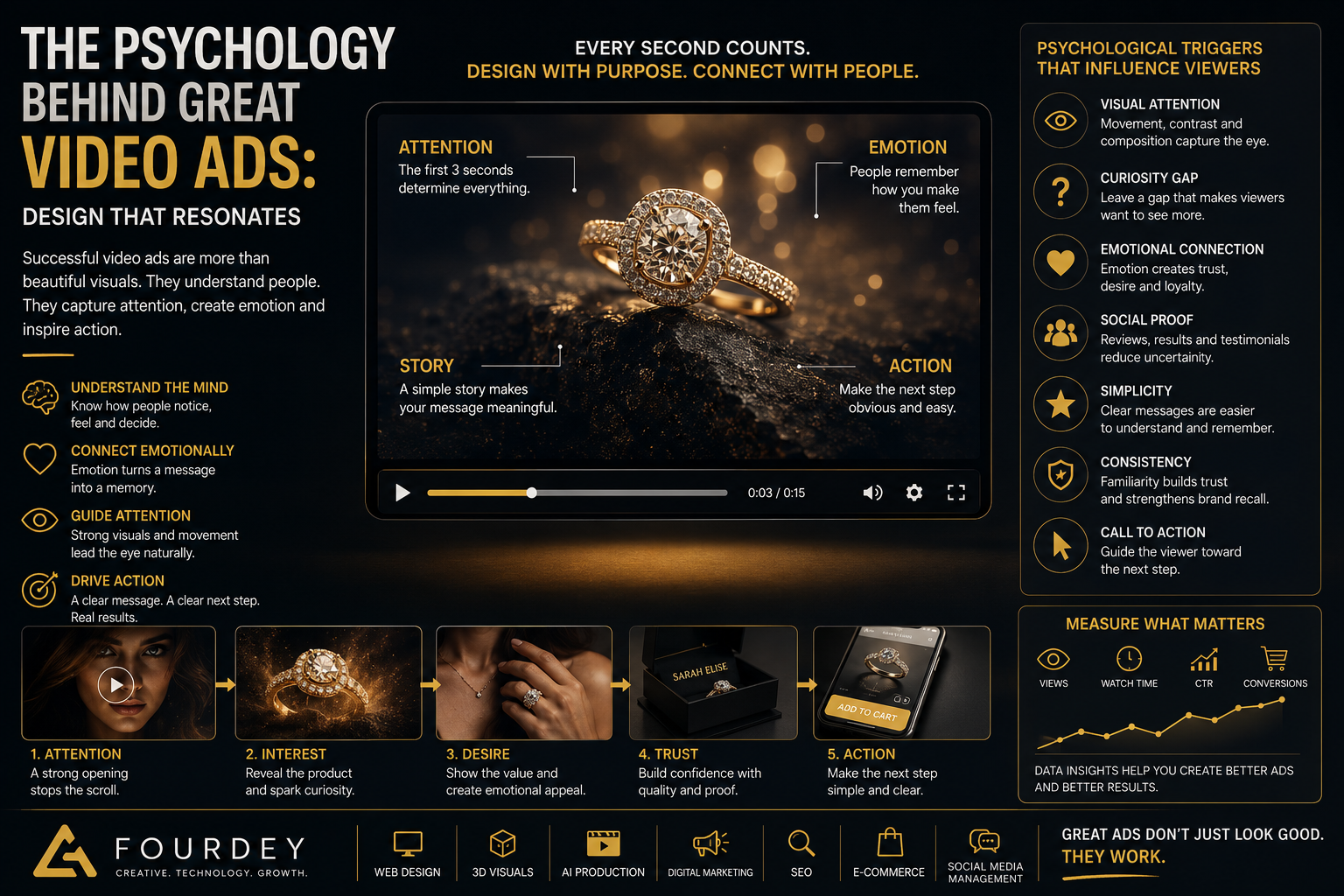
Modern audiences do not simply watch advertisements. They interpret them almost instantly.
Within the first few moments, viewers decide whether a video feels relevant, trustworthy, interesting or easy to ignore. Colour, movement, sound, composition, facial expressions and product presentation all influence that decision before the audience has fully processed the message.
This is why successful video advertising depends on more than impressive visuals. It requires an understanding of how people notice information, respond emotionally and make decisions.
At Fourdey, we combine creative strategy, visual storytelling, AI-powered production and digital marketing to create video advertisements designed not only to be seen, but to be remembered and acted upon.
Why Psychology Matters in Video Advertising
People rarely analyse every advertisement carefully. Most decisions happen quickly and intuitively.
When someone encounters a video while scrolling through social media, the mind immediately asks several unconscious questions:
- Is this relevant to me?
- Do I understand what I am seeing?
- Does this feel credible?
- Is there a reason to continue watching?
- How does this product or brand make me feel?
- What am I expected to do next?
A strong video answers these questions through visual structure rather than lengthy explanation.
The audience should quickly recognise the subject, understand the emotional direction and feel that the content is worth their attention.
Good advertising design reduces confusion. Great advertising design creates connection.
The First Seconds: Attention Before Explanation
The opening of a video advertisement has one primary responsibility: giving the viewer a reason not to continue scrolling.
This does not always require loud effects or rapid editing. Attention can also be created through elegance, mystery, unexpected movement or a carefully controlled product reveal.
Effective opening techniques may include:
- A visually unusual environment
- Immediate product movement
- A close-up detail
- A human expression
- A transformation
- Strong contrast
- A direct problem
- A question that creates curiosity
The opening should introduce the visual promise of the advertisement. If the beginning feels generic or unrelated to the product, viewers may leave before the main message appears.
Practical Tip
Show the product, problem or central idea early. Do not make the audience wait too long to understand what the advertisement is about.
A cinematic introduction should support clarity, not delay it.
The Curiosity Gap
People naturally want to complete unfinished information.
When an advertisement reveals enough to create interest but not enough to provide an immediate conclusion, the viewer may continue watching to understand what happens next.
This is known as a curiosity gap.
A ring slowly emerging from golden particles, a mysterious silhouette approaching a luxury product or an unexpected transformation can create this effect.
However, curiosity should not become confusion.
The audience must still understand that the video is leading toward something relevant. A completely abstract opening may attract attention but fail to communicate the brand or product.
The most effective curiosity gaps create a clear question:
- What is being revealed?
- How will this transformation end?
- What makes this product different?
- What is the character about to discover?
The answer should arrive at the right moment and reward the viewer’s attention.
Emotion Creates Memory
People may forget the technical details of an advertisement, but they often remember how it made them feel.
Emotion helps information become more meaningful. A product presented through confidence, excitement, elegance, nostalgia or aspiration can create a stronger impression than a simple list of features.
Different emotional directions support different brand goals.
Luxury and Desire
Slow movement, refined lighting, controlled sound and detailed close-ups can create a sense of rarity and exclusivity.
Trust and Security
Natural expressions, clear explanations, balanced composition and realistic environments can make a service feel more dependable.
Excitement and Innovation
Dynamic transitions, futuristic environments and energetic pacing can support technology or product-launch campaigns.
Warmth and Connection
Human interaction, familiar situations and gentle storytelling can create empathy and emotional closeness.
The emotional tone should always match the product and audience. A luxury jewelry campaign and a fast-moving technology advertisement may require completely different visual psychology.
The Power of Visual Hierarchy
Every frame contains several competing elements: the product, people, text, background, logo and movement.
Visual hierarchy determines what the viewer notices first.
A strong composition guides the eye naturally from the most important element to the supporting information. This may begin with the product, continue toward a headline and finish with the call to action.
Hierarchy can be created through:
- Size
- Contrast
- Position
- Focus
- Lighting
- Movement
- Colour
- Empty space
When too many elements compete equally, the advertisement becomes difficult to understand.
Practical Tip
Ask one simple question when reviewing every scene:
What should the viewer notice first?
If the answer is not immediately clear, the composition may need to be simplified.
Colour and Emotional Association
Colour influences atmosphere and perception.
Although colour meanings can change across cultures and industries, consistent visual associations still help shape the emotional tone of an advertisement.
Black
Often communicates sophistication, control, exclusivity and premium positioning.
Gold
Can suggest luxury, value, success and craftsmanship.
Blue
Commonly supports feelings of trust, intelligence and reliability.
Green
May communicate nature, health, growth or sustainability.
Red
Creates intensity, urgency, passion and strong visual attention.
White
Can suggest clarity, simplicity, purity and modernity.
Colour should not be chosen only because it looks attractive. It should support the identity of the brand and the emotional purpose of the campaign.
For Fourdey, black, white and yellow create a visual language that combines professionalism, creativity and forward movement.
Movement Directs Attention
The human eye is naturally attracted to movement.
In video advertising, camera motion, product animation and environmental movement can guide attention toward the most important part of the frame.
Examples include:
- A camera moving toward the product
- Light travelling across a gemstone
- A hand entering the frame
- Particles forming a logo
- A product rotating slowly
- A chart rising behind the main message
Movement becomes more effective when it has a clear purpose.
Unnecessary camera motion can make an advertisement feel unstable or distracting. Controlled movement creates confidence and gives the audience time to understand the product.
For luxury products, slower and more deliberate movement often feels more premium. For performance-focused campaigns, faster pacing may create energy and urgency.
Faces, Expressions and Human Connection
People naturally pay attention to faces.
A genuine smile, focused expression or moment of surprise can quickly communicate emotion. Viewers may also follow the direction of a person’s gaze, making human characters useful for guiding attention toward a product or message.
However, the performance must feel believable.
Artificial expressions, unnatural movement or characters who do not fit the target audience can reduce trust. This is especially important in AI-generated video production, where facial consistency and body movement require careful quality control.
The strongest use of people in advertising is not simply showing an attractive character. It is creating a human moment that supports the message.
Social Proof Reduces Uncertainty
Customers often look to the experiences of others before making decisions.
Reviews, ratings, customer stories, completed projects and visible signs of satisfaction can increase confidence because they reduce the feeling of risk.
In video advertising, social proof may appear through:
- Authentic customer testimonials
- Product ratings
- Real project results
- Client logos used with permission
- User-generated content
- Before-and-after examples
- Visible customer reactions
Social proof must be truthful and verifiable. Invented testimonials, unconfirmed partnerships or unrealistic performance claims can damage trust.
When real data is unavailable, the advertisement should focus on process, quality and value rather than presenting fictional numbers as proven results.
Familiarity Builds Trust
People tend to feel more comfortable with things they recognise.
Consistent branding across videos, websites, social media posts and advertisements helps audiences become familiar with the company.
This includes consistent use of:
- Logo
- Colours
- Typography
- Music style
- Editing rhythm
- Product presentation
- Tone of voice
- Visual atmosphere
Repeated exposure to a coherent brand identity can make the company feel more established and trustworthy.
Consistency does not require every video to look identical. Different campaigns can explore new visual worlds while preserving recognisable brand elements.
Story Structure Gives the Viewer Direction
Even a short advertisement benefits from a clear narrative.
A simple structure may follow four stages:
1. Attention
Introduce a strong visual, problem or emotional moment.
2. Interest
Reveal the product, service or central idea.
3. Value
Show how the product improves the situation, creates emotion or delivers a benefit.
4. Action
Guide the viewer toward the next step.
This structure can exist within a six-second advertisement or a longer cinematic brand film.
The story does not need complex characters or dialogue. A product transformation, visual journey or carefully timed reveal can provide enough narrative to keep the audience engaged.
The Importance of Cognitive Simplicity
The brain prefers information that is easy to process.
When an advertisement includes long text, multiple messages, several products and constant visual movement, the viewer may struggle to identify what matters.
Cognitive simplicity means reducing unnecessary effort.
A clear video advertisement usually has:
- One main message
- One primary product or service
- One emotional direction
- One visual style
- One clear call to action
This does not make the advertisement basic. It makes the communication stronger.
Luxury design often feels powerful precisely because it removes unnecessary elements and gives the product more visual space.
Sound Shapes Emotional Perception
Sound influences how viewers interpret what they see.
The same scene can feel elegant, tense, emotional or energetic depending on the music and sound design.
Audio may include:
- Music
- Ambient sound
- Product sounds
- Voice-over
- Transitions
- Silence
Silence can also be powerful. A brief quiet moment before a product reveal may increase anticipation and make the following sound more impactful.
Social media videos should still communicate effectively without audio because many viewers initially watch with the sound turned off. Visual storytelling, subtitles and clear product presentation remain essential.
Pacing and Audience Retention
Pacing determines how quickly information is introduced and how long each scene remains visible.
When editing is too slow, viewers may lose interest. When it is too fast, they may not understand the message.
The ideal rhythm depends on:
- Platform
- Audience
- Product
- Campaign objective
- Emotional tone
- Video duration
A premium jewelry film may use slow, detailed close-ups. A short Meta advertisement may require quicker product visibility and faster transitions.
The pacing should build naturally toward the key moment rather than remaining at the same intensity throughout the entire video.
Why Product Integrity Matters
Creative environments may attract attention, but the product must remain accurate and recognisable.
This is especially important for jewelry, fashion, cosmetics and branded products. If the shape, gemstone, logo or material changes between scenes, the audience may lose trust.
AI-powered video production therefore requires strong reference materials and careful review.
Helpful resources include:
- High-resolution product photographs
- Multiple viewing angles
- Transparent-background images
- Approved 3D models
- Material references
- Accurate opening and closing frames
The creative world should elevate the product, not redesign it unintentionally.
Designing for the Customer’s Desired Identity
People often purchase products not only for what they do, but for what they represent.
A luxury watch may represent achievement. A ring may represent commitment. A business service may represent confidence and professional growth.
Effective advertising helps the viewer imagine the product as part of their desired identity.
This can be communicated through:
- Lifestyle environments
- Emotional moments
- Aspirational characters
- Symbolic storytelling
- Product styling
- Brand language
The advertisement should not only answer, “What is this?”
It should also answer:
“Who could I become with this?”
The Call to Action Should Feel Natural
A call to action is most effective when it feels like the logical conclusion of the story.
After creating attention, emotion and understanding, the advertisement should make the next step simple.
Examples include:
- Explore the Collection
- Discover the Product
- Start Your Project
- Book a Consultation
- Shop Now
- Learn More
- Watch the Full Story
The call to action should match the audience’s stage in the customer journey.
Someone seeing the brand for the first time may respond better to Discover the Collection than an aggressive purchase message. Retargeting audiences may be ready for a more direct action.
How AI Expands Psychological Storytelling
AI video production makes it possible to create symbolic, emotional and imaginative scenes without the complete limitations of traditional filming.
Brands can visualise abstract ideas such as:
- Transformation
- Innovation
- Heritage
- Freedom
- Ambition
- Luxury
- Discovery
A jewelry piece can emerge from a historic environment, a technology product can appear inside a futuristic city or a service can be represented through a visual journey from confusion to clarity.
The technology creates new creative possibilities, but psychology determines whether those visuals connect with the viewer.
The most effective AI advertisement is not the one with the most complicated scene. It is the one where every scene supports the same emotional and commercial message.
Testing Creative Psychology
Different audiences may respond to different visual approaches.
Digital advertising allows brands to test variations such as:
- Emotional versus product-focused openings
- Human characters versus product-only films
- Slow luxury pacing versus faster editing
- Different headlines
- Alternative calls to action
- Different first frames
- Shorter and longer edits
Performance can then be reviewed through metrics such as:
- Watch time
- Audience retention
- Click-through rate
- Landing-page activity
- Product views
- Enquiries
- Purchases
- Advertising conversions
Testing helps transform creative assumptions into informed decisions.
Common Psychological Mistakes in Video Ads
Trying to Communicate Everything
Too many messages reduce clarity and make the advertisement harder to remember.
Delaying the Product Reveal
Viewers may leave before understanding what is being advertised.
Using Emotion Without Relevance
A beautiful emotional story has limited commercial value if the audience cannot connect it with the product.
Overloading the Frame
Too much text, movement or interface detail increases cognitive effort.
Making Unrealistic Claims
Exaggerated results and unverified numbers reduce credibility.
Using an Unclear Call to Action
The viewer may enjoy the video but remain unsure about what to do next.
Ignoring Platform Behaviour
A cinematic website film may need a different opening, duration and composition when adapted for social advertising.
Our Approach at Fourdey
At Fourdey, we develop video advertisements through a combination of strategy, visual psychology and production technology.
Our process considers:
- Audience behaviour
- Campaign objective
- Emotional direction
- Opening hook
- Product visibility
- Brand consistency
- Story structure
- Platform format
- Editing rhythm
- Call to action
- Performance analysis
We combine AI video production, 3D visualization, web design and digital marketing to create connected campaigns where the advertisement and customer journey support the same message.
Final Thoughts
Great video advertisements are not successful simply because they look expensive or use new technology.
They succeed because they understand people.
They attract attention without creating confusion. They use emotion without losing the product. They make information easy to process, create a memorable feeling and guide the viewer toward a clear next step.
When psychology, design and storytelling work together, video advertising becomes more than content. It becomes a carefully designed experience that helps audiences notice, understand and connect with a brand.
At Fourdey, we create advertising films designed to resonate—combining human insight with AI-powered creativity and strategic digital execution.