
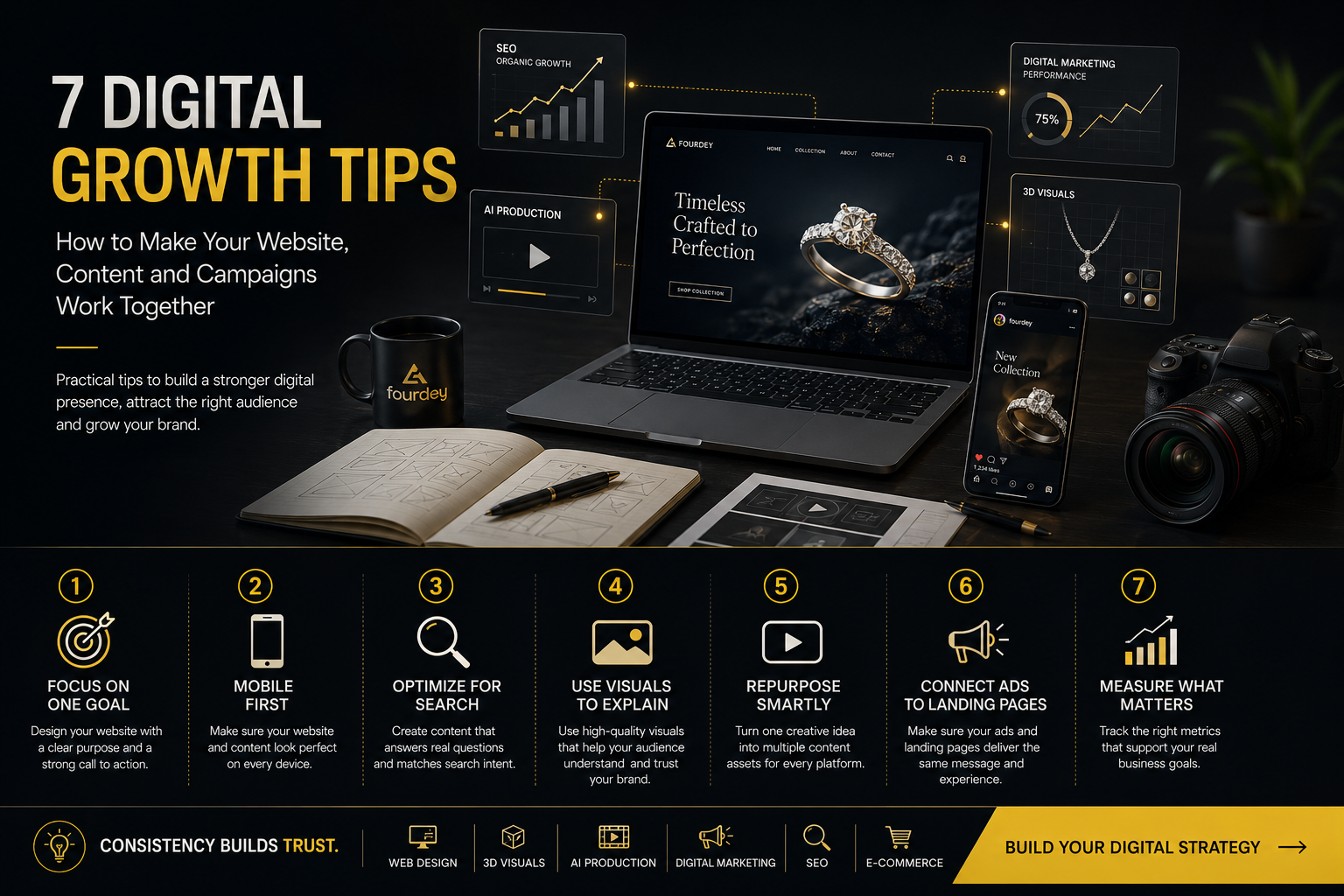
A strong digital presence is not created by one attractive website, one successful advertisement or one viral social media video. Sustainable growth happens when design, content, technology and marketing work together as one connected system.
Your website should support your advertising campaigns. Your product visuals should strengthen your e-commerce pages. Your AI videos should reflect the same identity as your social media content. Your SEO strategy should help the right audience discover everything you create.
Here are seven practical tips to help your brand build a clearer, stronger and more effective digital presence.
1. Design Your Website Around One Clear Goal
Many websites try to communicate too many ideas at once. When every service, product and message receives equal attention, visitors may not understand what they should do next.
Before designing a page, define its primary goal:
- Purchase a product
- Request a quotation
- Book a consultation
- Explore a collection
- View a portfolio
- Contact the company
Every headline, visual and call-to-action button should guide the visitor toward that objective.
Quick Tip
Use one main call to action in the hero section. Secondary actions can appear further down the page, but the opening screen should remain focused.
Instead of using a generic button such as Learn More, choose a more specific action:
Start Your Project
Explore the Collection
Request a Consultation
Build Your Shopify Store
Clarity makes decisions easier—and easier decisions can support stronger conversions.
2. Create for Mobile Before You Publish
Most digital content is now viewed on smaller screens. A website or campaign may look impressive on a large desktop monitor but lose its impact when displayed on a smartphone.
Mobile optimization should be considered from the beginning, not added at the end.
Check whether:
- Headlines remain readable
- Buttons are easy to tap
- Product images are clear
- Videos fit vertical screens
- Important information appears early
- Pages load quickly
- Forms are simple to complete
Quick Tip
Test every important page on a real mobile device before launch. Do not rely only on the preview inside your website editor.
Also review the page using mobile internet rather than a fast office connection. This gives you a more realistic understanding of the customer experience.
3. Build Every Page Around Search Intent
SEO is not only about adding keywords to a page. It begins with understanding what the potential customer is actually trying to find.
Someone searching for 3D jewelry rendering may want to compare services, review examples, understand pricing or learn which files are required.
A useful service page should answer those questions clearly.
For each page, identify:
- The main search topic
- The audience’s problem
- The information needed before purchasing
- Common questions
- The next logical action
Use this information to structure the title, headings, paragraphs and FAQ section.
Quick Tip
Give every important page a unique title and purpose. Avoid creating several pages that repeat the same information with slightly different keywords.
A clear structure is more valuable than publishing large amounts of similar content.
4. Use Visuals to Explain, Not Only Decorate
High-quality visuals should help the audience understand the product, service or brand story.
For product-focused businesses, especially jewelry brands, visuals can communicate details that written descriptions cannot fully express:
- Gemstone shape
- Setting structure
- Metal colour
- Surface finish
- Product proportions
- Light reflections
- Alternative material options
Photorealistic 3D rendering allows brands to present these details even before every physical product is available.
Quick Tip
Use different visual types for different stages of the customer journey:
Product pages: clean and informative renders
Website banners: emotional campaign visuals
Social media: dynamic and attention-grabbing scenes
Wholesale presentations: consistent multi-angle images
Advertisements: product-focused visuals with a clear message
Do not use the same image everywhere simply because it is available. Adapt the visual to the purpose of the page or campaign.
5. Turn One Creative Idea Into Multiple Content Assets
Creating new content for every platform can become expensive and difficult to manage. A better approach is to develop one strong campaign concept and adapt it into several formats.
One AI-powered advertising film can become:
- A 15-second campaign video
- A 6-second advertisement
- An Instagram Reel
- A YouTube Short
- A silent website hero loop
- A collection teaser
- Several campaign still images
- Story-format content
- Product-page animations
This approach improves consistency while helping the brand produce more usable content from one creative direction.
Quick Tip
Plan the required formats before production begins.
For example, if the campaign will be used on both a website and Instagram, compose key scenes so that the product remains visible in both horizontal 16:9 and vertical 9:16 versions.
Cropping should never remove the product, logo or most important action.
6. Connect Advertising With the Landing Page
A common digital marketing mistake is sending every advertisement to the homepage.
The visitor clicks an advertisement because of a specific product, service or promise. If the destination page does not immediately continue that message, the customer journey becomes confusing.
The advertisement and landing page should share:
- The same product or service
- A consistent headline
- Similar visual language
- The same promotional message
- A clear call to action
Quick Tip
Create dedicated landing pages for important campaigns.
For example, an advertisement for AI Video Production for Jewelry Brands should lead to a page that immediately presents:
- Jewelry-focused AI video examples
- Key advantages
- The production process
- Frequently asked questions
- A clear project inquiry button
The customer should not need to search the entire website to find the information promised in the advertisement.
7. Measure What Supports the Business Goal
Large numbers can look impressive, but not every metric represents meaningful progress.
A video may receive thousands of views without generating qualified interest. A website may attract traffic without producing enquiries. A social media post may receive likes without supporting sales.
The metrics you monitor should reflect the purpose of the campaign.
For Awareness Campaigns
Focus on:
- Reach
- Video views
- Watch time
- Audience retention
- Brand searches
- Engagement
For Lead Generation
Focus on:
- Form submissions
- Cost per lead
- Qualified enquiries
- Consultation bookings
- Landing-page conversion rate
For E-Commerce
Focus on:
- Product views
- Add-to-cart activity
- Checkout initiation
- Completed purchases
- Conversion rate
- Return on advertising spend
Quick Tip
Do not evaluate campaigns using only one metric.
A low click cost may appear positive, but the traffic may not be relevant. A smaller number of highly qualified visitors can be more valuable than a large amount of low-intent traffic.
Always connect marketing data with actual business outcomes.
Bonus Tip: Keep the Brand Experience Consistent
Your website, advertising, product visuals and social media content should feel like parts of the same brand.
Maintain consistency in:
- Logo usage
- Typography
- Colour palette
- Lighting style
- Image quality
- Tone of voice
- Product presentation
- Calls to action
Consistency creates recognition. Recognition helps build familiarity, and familiarity can develop into trust.
This is particularly important when multiple services or production partners are involved. A unified creative direction prevents the brand from appearing fragmented across different platforms.
A Practical Digital Growth Checklist
Before launching your next website, campaign or collection, ask:
Website
Is the primary goal immediately clear?
Does the page work properly on mobile?
Is the main call to action easy to find?
SEO
Does the page answer a real customer question?
Are the title and headings specific?
Is the content unique and useful?
Visuals
Do the images explain the product or service?
Are product details accurate and consistent?
Are the files optimized for the platform?
AI Video
Does the opening capture attention quickly?
Is the product visible and stable?
Can the main film be adapted into multiple formats?
Digital Marketing
Does the advertisement match the landing page?
Is conversion tracking configured correctly?
Are you measuring results connected to the business goal?
Final Thoughts
Digital success does not come from treating web design, SEO, advertising, 3D visualization and AI video production as unrelated services.
The strongest results appear when every element supports the same customer journey.
A clear website creates trust. SEO improves discoverability. High-quality visuals communicate value. AI-powered videos attract attention. Digital marketing connects the message with the right audience. Performance data then helps improve the entire system.
At Fourdey, we bring these capabilities together to help brands create digital experiences that are visually distinctive, strategically connected and designed to support measurable growth.